BY:


Building a greener future: Affordable housing leading the way with EDGE certification
January 22nd, 2026
FSD Kenya’s partner Kwangu Kwako Ltd (KKL), has achieved EDGE Advanced Certification for its 42 unit housing unit development in Kawangare. This achievement shows that sustainable living need not be a luxury and is achievable in the affordable housing sector.
What is EDGE green building certification and why does it matter?
EDGE (Excellence in Design for Greater Efficiencies) is a globally recognized green building certification system created by the International Finance Corporation (IFC), a member of the World Bank Group. The EDGE basic certification requires a minimum of 20% efficiency in energy, water, and embodied materials compared to a local benchmark. EDGE Advanced Certification is achieved when the project meets the EDGE basic criteria (above) and reaches 40% energy savings.
The EDGE certification of KKL’s housing project is crucial for the wider affordable housing sector because it validates green performance in the affordable housing sector with a measurable and internationally recognised standard. This achievement also validates that local innovation can promote homes that are more comfortable, healthier and affordable to their residents.
The ingenuity of affordable green housing: Designing for efficiency
In reality, the design philosophy behind affordable green housing often prioritizes core efficiencies that inherently lead to sustainability and cost savings, even if it means foregoing certain features typically found in high-end developments. KKL optimized the fundamentals to deliver a comfortable and efficient living space by:
- Thoughtful resource management, not just high-tech additions: Affordable housing of course cannot build in energy-intensive air conditioning. KKL’s designs prioritise natural ventilation and strategic window placement for passive cooling. While washing machines are uncommon in affordable housing, and personal refrigeration may not be a standard inclusion in every unit, the overall design might encourage communal laundry facilities or simply allow residents to integrate their own appliances efficiently.
- Maximising space and light: KKL emphasised ample natural light and smart layouts to reduce need for artificial lighting during the day. The income tier KKL targets also does not use cars, so the provision of traditionally allocated extensive parking spaces was reduced. All light fittings were energy efficient.
- Effective water management: Rainwater harvesting, even without complex treatment for potable use, can still significantly contribute to water savings for non-potable uses like irrigation or flushing, reducing overall reliance on municipal water supplies. The focus is on practical, impactful solutions. EDGE now recognises rainwater used for suitable non-potable uses (e.g. flushing, irrigation, clothes washing etc.).
These design choices, while driven by affordability, directly contribute to the significant energy and water savings, leading to lower operational costs for the occupiers. These savings are tangible even if they aren’t always explicitly itemized in initial project cost analyses.
Smart material choices: Global sourcing for green impact
KKL’s success in achieving significant embodied carbon savings at affordable pricing was driven by efficient design. This includes the use of precast concrete panels for walls, steel window frames, and ceramic tiles for flooring, using less well known, but equally effective brands. These materials, often manufactured with cost-efficiency in mind, deliver the same crucial results: durability, efficiency, and a reduced environmental footprint.
Accepting and embracing locally manufactured goods is not a compromise; it’s a strategic pathway to making green building truly accessible and impactful. These materials were initially not validated by EDGE (as they are from smaller suppliers who cannot afford the certification process), but have since been accepted as compliant through audit verification of performance (datasheets/testing) enabling locally supplied products to be credited. This is a testament to an evolving certification process.
Kwangu Kwako’s achievements with EDGE Advanced Certification
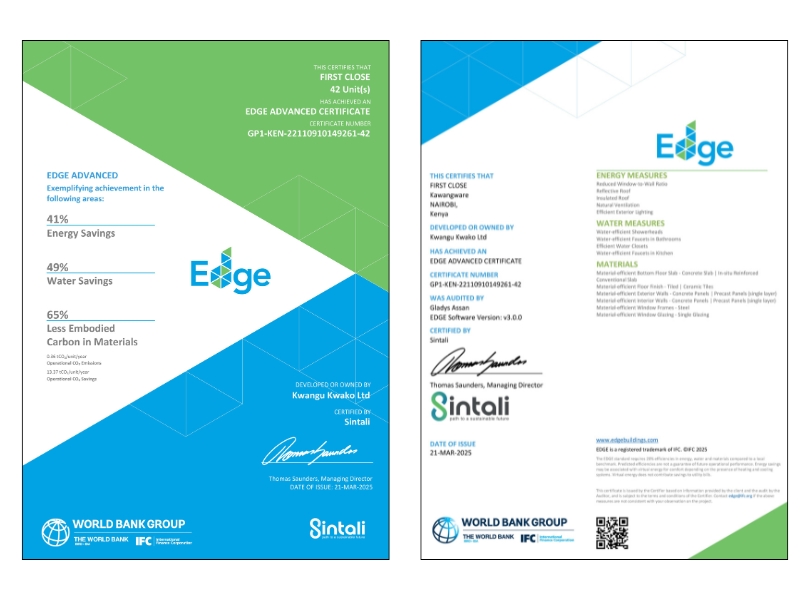
KKL project delivered 42 housing units and achieved EDGE Advanced Certificate (which is much more environmentally sustainable than EDGE Basic). The project demonstrates:
- 41% Energy Savings achieved through a reduced window-to-wall ratio, a reflective roof, an insulated roof, natural ventilation, and efficient exterior lighting. To put this in perspective, these energy savings are equivalent to powering approximately 10 average Kenyan homes for a year.
- 49% Water Savings achieved by incorporating water-efficient showerheads, faucets in bathrooms and kitchens, and efficient water closets. This is the equivalent of saving enough water to fill over 100 water tanks of 10,000-litre capacity every year.
- 65% Less Embodied Carbon in Materials made possible by selecting material-efficient options like concrete slab for the bottom floor slab, tiled ceramic tiles for the floor finish, and precast concrete panels for exterior and interior walls. KKL also utilized steel for window frames and single glazing for windows. This reduction in embodied carbon is comparable to taking approximately 20 cars off the road for a year.
- Operational CO₂ Emissions: KKL achieves total Operational Savings of 13.37 tCO2e per year across all 42 units. This means the remaining Operational CO2 Emissions for a single unit are approximately tCO2e per unit per year. (tCO₂ refers to one metric tonne of carbon dioxide). These savings are equivalent to planting over 2,200 trees annually that grow for 10 years, absorbing carbon dioxide from the atmosphere.
Affordable housing: A cornerstone of green building
KKL’s EDGE Advanced certification powerfully demonstrates that affordable housing is not just a viable candidate for green building, but a critical contributor. Despite the focus on simplicity and affordability, these projects can deliver substantial environmental benefits and cost savings for the occupiers.
The majority of the population resides in affordable housing, and by integrating green building principles into this sector, the housing sector can achieve a far greater impact on reducing overall energy consumption, water usage, and carbon emissions within an economy.
Making green building accessible: An opportunity for scaling certification and environmental savings
While the benefits of EDGE certification are clear, the initial assessment cost can be a significant consideration for affordable housing developers. This assessment was supported financially and with technical assistance by FSD Kenya and Reall and cost $6,450 for 42 homes (equating to approximately $154 per home). The process also took 4-5 months, partly as it was being done retrospectively and it was KKL’s first application.
More innovative approaches to the pricing of certification will encourage more uptake of green building standards. Imagine the collective impact if every affordable housing project, no matter its simplicity, could easily pursue green certification. There is a compelling opportunity for a project cost-based assessment model or a blanket assessment cost specifically tailored for affordable housing portfolios. By offering a more streamlined or volume-based pricing structure, certification bodies in collaboration with IFC and EDGE could incentivise broader adoption. This would be a win-win for all, as individual developers would find the certification more affordable, the volumes of certification should go up and the local skill set of certifiers can deepen. The intended goal of greater collective savings in energy, water, and embodied carbon would deliver significant environmental benefits on a national scale
The opportunity of green building financing for affordable housing
This success also highlights a significant opportunity for green building financing to flow into the affordable housing sector. Investing in green affordable housing projects not only contributes to a healthier planet but also provides long-term savings for residents through reduced utility bills and potentially a healthier home. For financial institutions, it presents a chance to support impactful projects that deliver both social and environmental returns.
Unlocking green financing for affordable housing
Green building financing offers a powerful opportunity to enhance affordable housing while supporting environmental and social impact. Projects with EDGE certification provide long-term savings for residents and attract mission-aligned financial institutions.
To scale adoption, the financing sector could:
- Cover upfront certification costs through low-interest loans or returnable grants.
- Promote construction and offtake finance for greener housing units collecting data on the delivery and operational costs differentials
- Offer performance-based incentives for higher certification levels.
- Support supply chains to increase availability of certified green materials.
- Link financing to post-construction operational sustainability.
Embedding certification costs into financing mechanisms can accelerate green housing growth, advance Kenya’s climate goals, and deliver lasting value for communities and investors alike. Policy makers can also support greater uptake by simplifying building approvals and providing a certain level of blanket approvals for validated typologies. It’s a win-win-win for people, planet, and prosperity.
Affordable housing is inherently green (due to lower construction material utilisation due to smaller unit sizes, lower water and energy utilisation (observed patterns in KKL audited units show lower average water and energy consumption together with lower car ownership than the local base case). However, this is not easily recognised in policy and financing circles. FSD is grateful to the partnership with KKL and Reall for pursuing the technical evaluation of an intentionally delivered affordable housing project. Another area for deliberation is how countries like Kenya who have heavily invested in powering its national energy grid with renewal sources can get adequate credit for this shift. Currently, standards like EDGE use the local benchmark, and recognise uplifts over that benchmark. However, there is a strong argument that buildings in Kenya are greener than buildings in other countries that do not have such a green source of the energy grid. We welcome ongoing dialogue with IFC/EDGE on how national clean grids are reflected in benchmarking.
We encourage developers, policymakers, and financial institutions to continue to collaborate to make such certification more accessible and adaptable to local realities.
Read the full report here – Update review of the EDGE certification process – Post audit affordable housing focus – A case study of Kwangu Kwako homes
Note: This blog reflects EDGE definitions and KKL audit outcomes as of June 2025.
TAGS
CATEGORIES
You might also like
March 3rd, 2026
Unlocking affordability: Reflecting on the affordable housing incentives program
Seeta Shah
February 25th, 2026
Even as health facilities get closer, transportation remains a barrier to care
John Mwangi
February 17th, 2026
Do market-led models build resilient and inclusive farming systems? Lessons from FSD Kenya’s poultry value chain project
Amrik Heyer


