BY:



From insight to action: Positioning insurance at the heart of women’s financial resilience
August 5th, 2026
Only 6.3% of Kenyan adults have private insurance in their own name, leaving more than 90% excluded across most population groups.
New analysis of data from the 2024 FinAccess Household Survey shows that this exclusion is not evenly distributed. It is concentrated among women and clustered in particular parts of the country, pointing to structural barriers that continue to limit participation in the insurance market.
These findings come at a time when Kenya is seeking to deepen women’s financial inclusion through the WE Finance Code, launched in December 2025 under the National Financial Inclusion Strategy (NFIS) and Medium-Term Plan IV. The Code brings together regulators, financial institutions and other ecosystem actors around a shared commitment to advance women’s financial inclusion through the use of sex-disaggregated data, target-setting and institutional accountability.
Insurance has not been central to discussions around the code so far. Yet the evidence suggests that it should be.
Insurance exclusion is widespread and unequal
Analysis of 2024 FinAccess data shows that insurance exclusion is both extensive and uneven. Women are consistently less likely than men to hold private insurance, while significant differences emerge across counties.
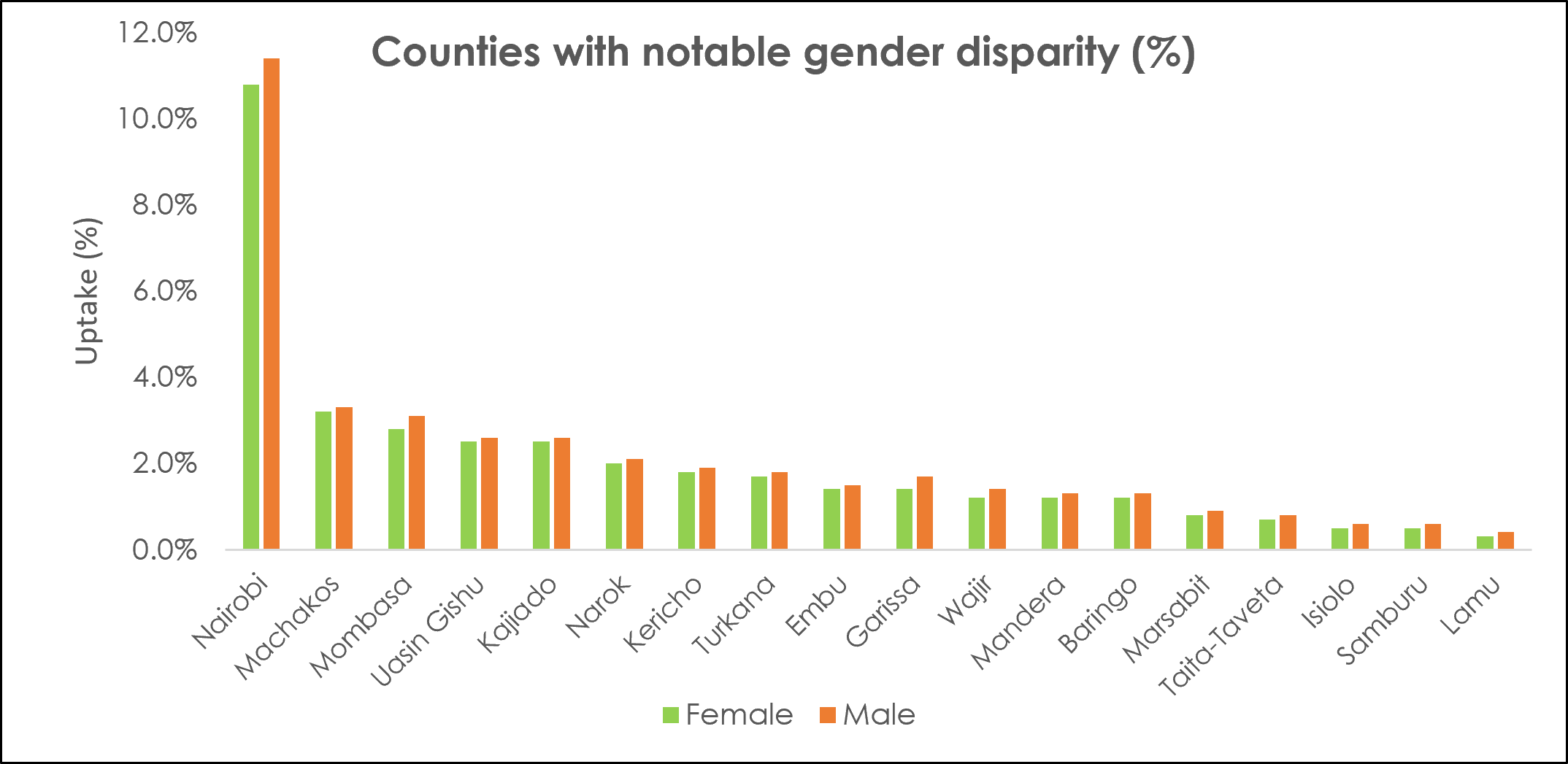
Figure 1: Insurance distribution by county
These patterns are explored in greater detail in the paper, Who is left behind? Exclusion paradoxes and clusters in Kenya’s private insurance market: Evidence from the 2024 FinAccess survey. The analysis combines predictive modelling and spatial diagnostics to identify forms of exclusion that are not immediately visible in headline indicators.
While overall uptake remains low, the data points to deeper patterns linked to gender, geography and socio-economic circumstances. The result is a picture of exclusion that is structured rather than incidental.
Why this matters now
On 4 December 2025, Kenya launched the WE Finance Code. The initiative is anchored in the National Financial Inclusion Strategy (2025–2028), and supported by a coalition of regulators, financial institutions and development partners working to improve access to financial services for women, particularly women-led MSMEs.
In Kenya, the Central Bank of Kenya serves as the national champion for the initiative under the leadership of Deputy Governor Dr Susan Koech. Since its launch, attention has increasingly turned towards implementation, including helping signatories translate broad commitments into measurable actions.
As that work continues, insurance presents an important opportunity to strengthen the Code’s focus on women’s financial resilience.
Too often, financial inclusion discussions focus primarily on access to credit. While credit is important, access to credit on its own does not protect households and businesses from shocks. Insurance does.
For women-led MSMEs, insurance can mean the difference between recovery and collapse following illness, theft, climate-related events or other disruptions. Without appropriate risk protection, progress achieved through savings and borrowing can be quickly reversed.
Insurance is therefore not a peripheral component of financial inclusion. It is part of the foundation that allows households and businesses to manage risk, preserve assets and sustain economic participation over time.
There are encouraging signs that insurance is becoming a more visible part of the broader financial inclusion agenda. This creates an opening for insurers and other market actors to engage more actively with the WE Finance Code and support commitments already made by the Insurance Regulatory Authority during the Code’s launch.
Looking beyond headline indicators
One of the clearest messages emerging from the analysis is the importance of looking beneath aggregate statistics.
Headline figures tell us that insurance uptake is low, but they do not tell us who is excluded, where exclusion is concentrated, or which groups face the greatest barriers.
The deeper analysis reveals gender disparities, persistent geographic clustering and patterns of exclusion that remain hidden when populations are viewed as a single national average.
Understanding these dynamics requires both demand-side and supply-side evidence.
Demand-side data helps explain who is excluded and the reasons people give for not using insurance. Supply-side data provides a different perspective:
- Who is being served
- What products they are using
- How those products are performing
- Where delivery gaps remain
For insurance providers, this level of insight matters.
Sex-disaggregated information on uptake, claims, product use and distribution channels can help answer practical questions about whether women are accessing insurance on the same terms as men, whether products reflect the realities of women’s businesses and incomes, and whether claims processes work effectively for female customers.
Without that evidence, interventions risk remaining broad rather than targeted.
Within the WE Finance Code, data can serve a purpose beyond reporting. It can help identify problems, inform product design and strengthen accountability for results.
Building on existing forms of resilience
The analysis also highlights an important reality often missed in discussions about insurance.
Many women are not entirely unprotected from risk. Instead, they rely on informal systems that have long provided support during periods of hardship.
Across Kenya, women and women-led MSMEs frequently turn to chamas, savings groups, family networks and community-based support structures when they experience shocks. These mechanisms help smooth consumption, mobilise resources and provide assistance during difficult periods.
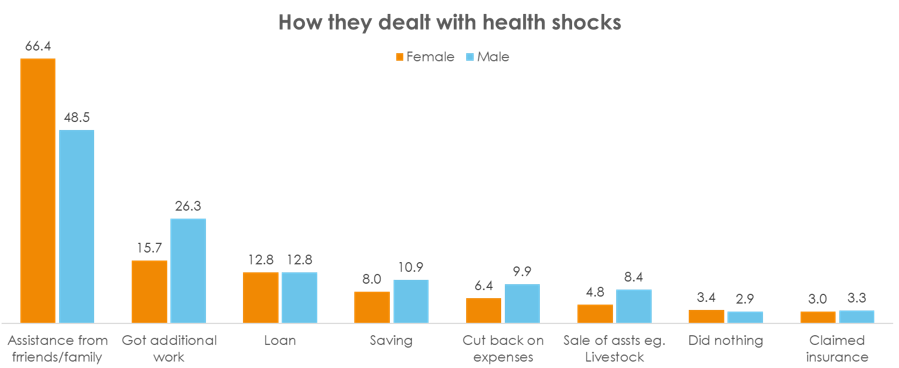
Figure 2: Dealing with health shocks, men and women
Total adults who dealt with health shocks as the main shock experienced = 4.16 million
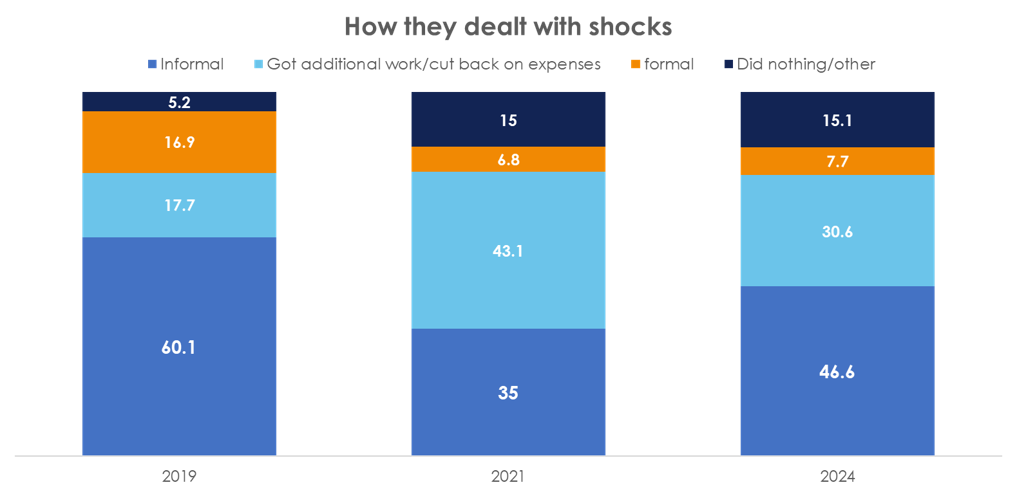
Figure 3: How they dealt with shocks
Rather than replacing these systems, formal insurance can build on them.
Group-based delivery models, products designed around irregular income patterns, and distribution channels rooted in trusted community networks may offer more effective ways of reaching women who are currently excluded from the market.
For insurers, this represents a commercial opportunity as much as a development objective.
From commitment to implementation
The geographic clustering identified in the analysis suggests that national approaches alone are unlikely to be sufficient.
Different groups experience exclusion in different ways, and responses will need to reflect those differences.
For regulators, this means expanding monitoring frameworks to include insurance as a component of financial health and using data to identify where exclusion is most concentrated.
For insurers and other financial service providers, it means engaging actively with the WE Finance Code, setting measurable targets for women’s inclusion, and developing products and delivery models that respond to the realities of women’s lives and businesses.
For the wider ecosystem, it means moving beyond a narrow focus on access and placing greater emphasis on resilience.
The evidence is clear. Insurance exclusion in Kenya is deep, geographically concentrated and shaped by gender. Progress will depend on better data, stronger collaboration and more deliberate efforts to design solutions around the people who remain excluded.
The WE Finance Code provides a platform for that work. The task now is to ensure that insurance is part of the agenda. Financial inclusion is not only about access to services. It is also about the ability to withstand shocks, adapt to changing circumstances and continue participating in economic life.
Click here for more information about the WE Finance Code.
Editor’s note: This article was updated on 10th August 2026 to improve structure, clarity and flow. No substantive changes have been made to the facts, analysis or conclusions presented in the original version.


