BY:



Compounding Costs and Confusion: Managing ovarian cysts in rural Kwale County - Kenya HealthFin Diaries Case Study 01
June 25th, 2026
M, 31, is an unemployed and illiterate mother of four children living in Kwale County and struggling with a challenging reproductive health issue.
While she calls the issue “nyama ya tumbo,” or fibroids, the official diagnosis in her records is hemorrhagic ovarian cysts. Her health finance experience over the last several months shows some common themes we see in the study: adverse selection into paying SHIF premiums, the hidden burdens of transportation costs and medical needs not covered by insurance, the ways those burdens ripple across families, and the painful opportunity costs low-income families experience when a working age adult can no longer work due to a health issue. M’s story shows how difficult it is for a family to manage a serious health issue, even when public subsidies shoulder the bulk of the cost.
M used to have NHIF when she was an EPZ worker before she got married. In those days, NHIF had been useful in managing her health care finances. But she left the job when she got married, and her husband, who drives matatus on a casual, on-and-off basis could not afford the premiums. However, when the family found out she needed another surgery, her fourth to treat this issue, in January, her husband paid the KShs. 4800 SHIF premiums to finance his wife’s care.
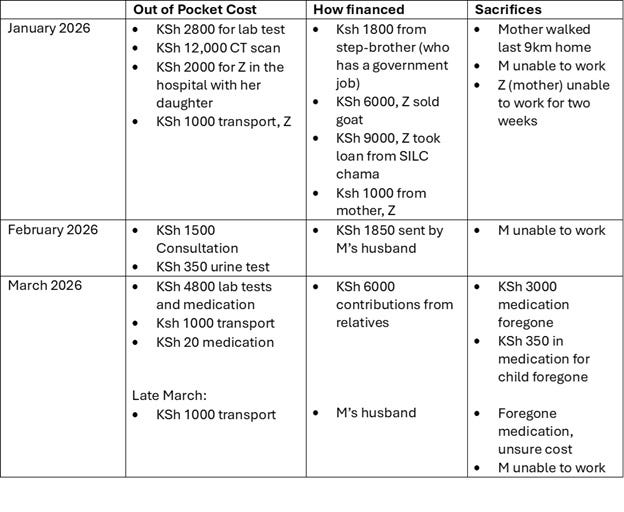
During that surgery, the doctors removed a 10-centimeter mass. After the surgery, she developed complications and was admitted for another 13 days. While she was covered by SHA, there were additional out of pocket expenses. The hospital lab was not dysfunctional, so they had to pay KShs. 2800 for a private lab to do the required tests. SHIF did not cover a CT scan that was needed, so M’s family needed to come up with about KShs. 12,000 for that. M’s mother, Z, who is also quite low income and often sleeps hungry, sold a goat for KShs. 6,000 and took a loan of KShs. 9,000 from her SILC group to cover the medical bills and her own transport to go take care of her daughter in the hospital. Since she didn’t have enough money to reach all the way home, she exited the matatu 9 kilometers before home and walked the rest of the way in the blazing coastal January sun.
Meanwhile, M went home, not far from the hospital to recover and returned for her follow up appointment in February. She was told by the hospital that SHIF was not working, so she had to pay KShs. 1500 for the consultation and KShs. 350 for a urine test out of pocket. M’s husband paid for these costs, though it was a challenge. He often only gets a few days of work at a time.
By March, the situation had become even more problematic because M and her family had exhausted all their financial resources due to repeated hospital visits, medication, and other related expenses. With no money left, she had to depend on family members and relatives to help raise funds. After reaching out to several people, they were only able to collect KSh 6,000, mostly from M’s siblings. They used KShs. 1000 of that money for transportation and KShs. 4800 for lab tests and medications only available outside the facility. M was prescribed one medication that cost KShs. 3,000 alone. With no additional funds available, M went without.
M also got some bad news during her checkup. Another growth had developed, and the doctor recommended yet another surgery, her fifth. She couldn’t believe this was happening so soon after the last surgery. Worried and confused, she questioned whether the growth was really new or whether the doctors performed the previous surgery incorrectly.
The news left her deeply worried and confused. She wondered whether the surgeon actually removed the entire growth or if they did something incorrectly, leaving her with this disruptive issue unresolved. How, she worried, would her family come up with the money for yet another surgery? What’s more, she was told not to work for six months while recovering from the surgery. Already depleted and the mother of four children, she faced not only a serious health crisis but also a deep financial and emotional burden. She worried constantly about her health, the possibility of undergoing another surgery, and how she would provide for her children during this difficult period. She decided to go stay with her mother, Z, since she wouldn’t be able to work and would need help taking care of herself.
Given persistent pain, before her hospital follow up, she went to a local dispensary in search of help. They told her that she really should buy the medication prescribed at the hospital. The dispensary itself didn’t have them in stock. She sat with her pain until her next follow up at the hospital. Meanwhile, her own child became sick with vomiting and diarrhea. They were given paracetamol at the dispensary, but could not afford the KShs. 350 for the other medication prescribed that was not available for free.
When M had her next follow up in late March, her husband came up with Ksh 1000 to help with transport costs. It’s KShs. 600 each way, so it didn’t cover all of her needs. This time, the facility said SHIF would cover an ultrasound, which showed that there was not another growth and that her pain was only from the deep wound of the surgery. She was given another prescription, and this time didn’t even bother to check what it would cost. There was no way she could spare even one shilling and still make it home. She did not want to stress herself over where to get additional funds, fearing it might worsen her condition. The doctor scheduled another follow up for a month later, but M said she probably won’t go since it’s such a burden to finance even the transport cost.
Table 1: M’s care costs and financing
Conclusions
M’s story reflects trends we see more widely across our diaries sample:
|
1. Adverse selection into SHA is the norm outside of the formally employed. Most of those in the informal sector in our study who have paid premiums for SHIF cover have done so because they have a high likelihood of needing inpatient care. They had already planned surgeries, are expecting to have a baby, have serious chronic illnesses, or have already been admitted to a hospital and paying SHA premiums was less than the expected hospital bill. It is unsurprising then, that the recent 2026 Kenya Economic Survey reported that the fund has paid out Ksh 91.5 billion against KSh 57.7 billion in collections. Even though premiums often are far less than the costs of care people need, they represent a substantial burden for low-income households, especially in the face of the high costs of school fees, food, and rent. (We will cover this in future reports and case studies.) 2. Transportation is a substantial barrier to affordable care. This is true for households in more remote areas, but even in urban ones, as we’ve written about here. Often transport costs change when there is rain and different roads flood. When people are sick or injured, they often cannot walk to the main center and have to hire motorbikes for last mile transport that can add significantly to the costs. 3. Even with SHIF cover, the cost burden of care can be substantial and ripples across the social network. M’s family has come up with KSh 27,470 over three months to help her get the care she needed. This has been a substantial burden for her husband, her mother, and her siblings. Her mother’s loan of KSh 9000 from her SILC and sale of a goat of KSh 6000 represent about seven months of her mother’s typical monthly monetary income. SHIF likely made it possible for M to get care, but it has not prevented the family from experiencing catastrophic health expenditure for the year. 4. Households often face serious distress over healthcare, especially treatment uncertainty, unsustainable costs, and lost income. Coping with this health issue has caused M, M’s husband, and Z all significant stress. M especially worries about whether her treatment will ever be complete, if she’s getting quality care, and if she’ll be able to continue to pay for the medicine and follow up she needs. She feels like she has let her family down, being unable to support her family with domestic chores or any kind of part time casual work. Everything is left to her husband who is trying to take care of the children and keep the family afloat while his wife recovers. Several households in the study have had someone fall into serious, clinical depression following health shocks like these that precipitate a downward spiral in livelihoods.
|
The Kenya HealthFin Diaries project follows ~300 households, visiting every two weeks to understand their incomes, expenditures alongside healthcare needs and utilisation. This case study is the first in an ongoing series of sharing individual stories that showcase themes emerging in the study.
TAGS
CATEGORIES
You might also like
September 24th, 2026
Smart water project launched in Kajire to deliver affordable, safe water to local communities
Communications
August 31st, 2026
Women, gum arabic and the promise of economic inclusion in Samburu
Communications
August 31st, 2026
How SUED is translating planning into finance, and finance into jobs
Duncan Oyaro
August 28th, 2026
From long journeys to local economic opportunity: Lentam Ntarawe’s gum arabic journey
Communications


